29Running Title
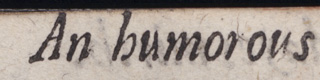
Holaday and Yamada agree that two skeleton formes were used in the printing of An Humorous Dayʼs Mirth, one each for the outer and inner formes. Several characteristics of the first half of the running title, ‘An humorousʼ, enable the use of these two skeleton formes to be traced through the printing of the play. As Holaday points out, sheet A needed setting with a title page and was therefore set specially.[171] The running titles were then transferred from sheet A to the skeleton formes for sheet B.
30To begin with, the outer forme is set with a pair of running titles, one of which has a swash A for ‘Anʼ (B2v) and one with a distinctive ‘uʼ and ‘usʼ ligature at B4v. The inner forme has a pair of running titles, which spell ‘humerousʼ with an ‘eʼ instead of an ‘oʼ, as in the outer pair. The re-usage of all but the swash ‘Aʼ running title of sheet A (as A1v is blank, being the verso of the title page) is evident in sheet B, although the outer skeleton has been transferred to the inner forme in the setting of sheet B. The skeleton formes are used consistently in this way for the inner and outer formes until sheet E, where the skeleton for the outer forme is used ‘upside downʼ and the spelling of ‘humerousʼ in the inner skeleton forme has been altered to ‘humorousʼ, as identified by Holaday.[172]
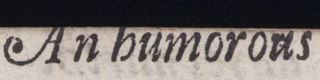
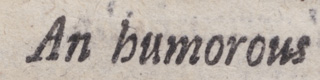
31At sheet F the outer skeleton forme is returned to its usual orientation (as in sheets B-D). By sheet G the outer skeleton forme has been altered once again, the joined ‘usʼ being removed but the distinctive ‘uʼ remaining in G4v. The spelling of ‘humorousʼ continues in sheets F and G in the inner skeleton forme after its alteration at sheet E.